

Looking For The Answer Inside Your Question
Essay in 12 Steps | TWO | "Without a question we are forever shut out of the inner life of one another." ~Paul Matthews

It was Rumi who said—inspiring the headline for this post, “Look for the answer inside your question.” Could there be a quote more apropos to essay writing, especially lyric essay writing? Probably not.
And speaking of the lyric essay and the Essay in 12 Steps Challenge … it’s Week Two already!
Before we dive in, I want to thank you for your support of not only me and my family and everyone else here in Minneapolis, but also in general, your support of using language as a tool for meaning and truth versus solely an aesthetic pursuit. If you missed the essay I’m referring to when I thank you for your support, you can find them here:
The Bird, The Tongue, The Cost: Why I’m Writing “Off Brand” and Support Others in Doing So, Too

Back to the Essay Intensive: During this past week, you have tolerated some discomfort of uncertainty while working with me to look closely at the world—more closely than is probably customary or painless for most of us. For seven straight days and almost 600 comment contributions to the cause!—we’ve felt our way along, noticing what catches our attention: those flickers of movement on the periphery, glints of light spilling across the surface.
We’ve described these shimmers and shards using concrete, objective language that stays in fragments rather than forming complete sentences, fragments that observe without judging or analyzing, that resist the rush to meaning, and that, most of all, hold back from narrating or story-making. We’ve described the world as it is without making it about us, at least for now. To do this means we have stepped back from habit and trusted instead in the quest to see just how “close up to the world” we can get with our words.
And did we? Did we get close up? Did we crawl under the skin of the world and feel its bony protrusions, its rough patches, its soft underbelly?
It seems to me we must have, based not only on the shimmers and shards you shared, but also based on your insightful comments and questions.
We’ve also tried to step back from our “skillfulness” with language (we are so skillful, it’s true, but we already know that; this challenge is for knowing something else, something deeper, something outside of ourselves).
We’ve refrained from applying words quickly as a way to impose our own meaning on the world (versus doing the slower work of discovering meaning in the outer world, which are two very different gestures). We’ve attempted to look with great curiosity at the thing itself and describe it in plain language—no comparisons, no metaphors, no story. And we’ve cheered each other on, answered each other’s questions, and inspired one another to look harder, longer, more. And to not know. To wonder.
You’ve told me it’s been hard but also exhilarating. That it’s changed your orientation to everyday life. One writer said:
“This is SO good for my mental health, all those other voices that usually appear while I’m writing and have even made me quit for months at a time—doing this, those voices STOP for a minute or two—and this feels miraculous today.”
By the way, here is where I say that if you have not joined us yet and want to, you can absolutely jump in!
We’ve only just begun, and you are never too late. Last week’s prompt (and the nearly 600 comments and questions in response to it!) is here. And you can upgrade your subscription below if you haven’t yet, to become a full participating member of Writing in the Dark, with all the support and community that entails for you and your creative practice.
A quick word about those almost 600 comments (and the auxiliary buzz in Shimmers & Shards, the Writing in the Dark chat): I promise that throughout the 12 weeks of this essay challenge, I will continue to participate as much as possible in the comments and chat and offer observations on your submissions as time permits.
So far, you’ve said that’s been valuable, and I am happy to do it—with the necessary disclaimer that based on volume of comments, I cannot respond to every single submission, but I’ll certainly be present. And if you skim the comments and read my responses to others, you’ll likely find valuable clarifications for yourself as well.
As for your specific craft questions, I’ll keep answering those, too. Sometimes several writers ask similar questions, in which case I might give one answer that addresses several overlapping queries. Therefore, again, I strongly recommend that everyone at least skim the comments and chat even if you don’t post there, because the ongoing discussion is a dynamic, detailed, and illuminating extension of the weekly posts—and a huge added value that’s part of your membership. You don’t want to miss it!

Meanwhile, to launch Week Two of the Essay in 12 Steps, we turn not to Annie Ernaux and “flat writing,” as I suggested in yesterday’s post that we would (I’m so sorry! We will be discussing Erneaux, but not quite yet! Don’t be mad at me, it’s coming, I promise).
Instead, this week’s structured exercise builds on your collection of shimmers/shards from last week, while also playing with the powerful concept of the question as part of the process of writing. We also explored the question in the 30-Day Creativity Challenge—so, for some of you, this will be an opportunity to go deeper with that questioning energy.
Here’s an excerpt from my April essay on questions:
If you’ve never pondered the power of the question as an integral tool in writing, consider this passage written by the daughter of the Swiss psychologist Jean Piaget:
Where does that little baby come from? I don’t know. Out of the wood. Are you dust before you are born? Are you nothing at all? Are you air? Babies don’t make themselves, they are air. Eggshells make themselves in hens. I think they are air too. Pipes, trees, eggshells, clouds. The door. They don’t make themselves. They have to be made. I think trees make themselves and suns too. In the sky they can easily make themselves. How is the sky made? I think they cut it out. It’s been painted.
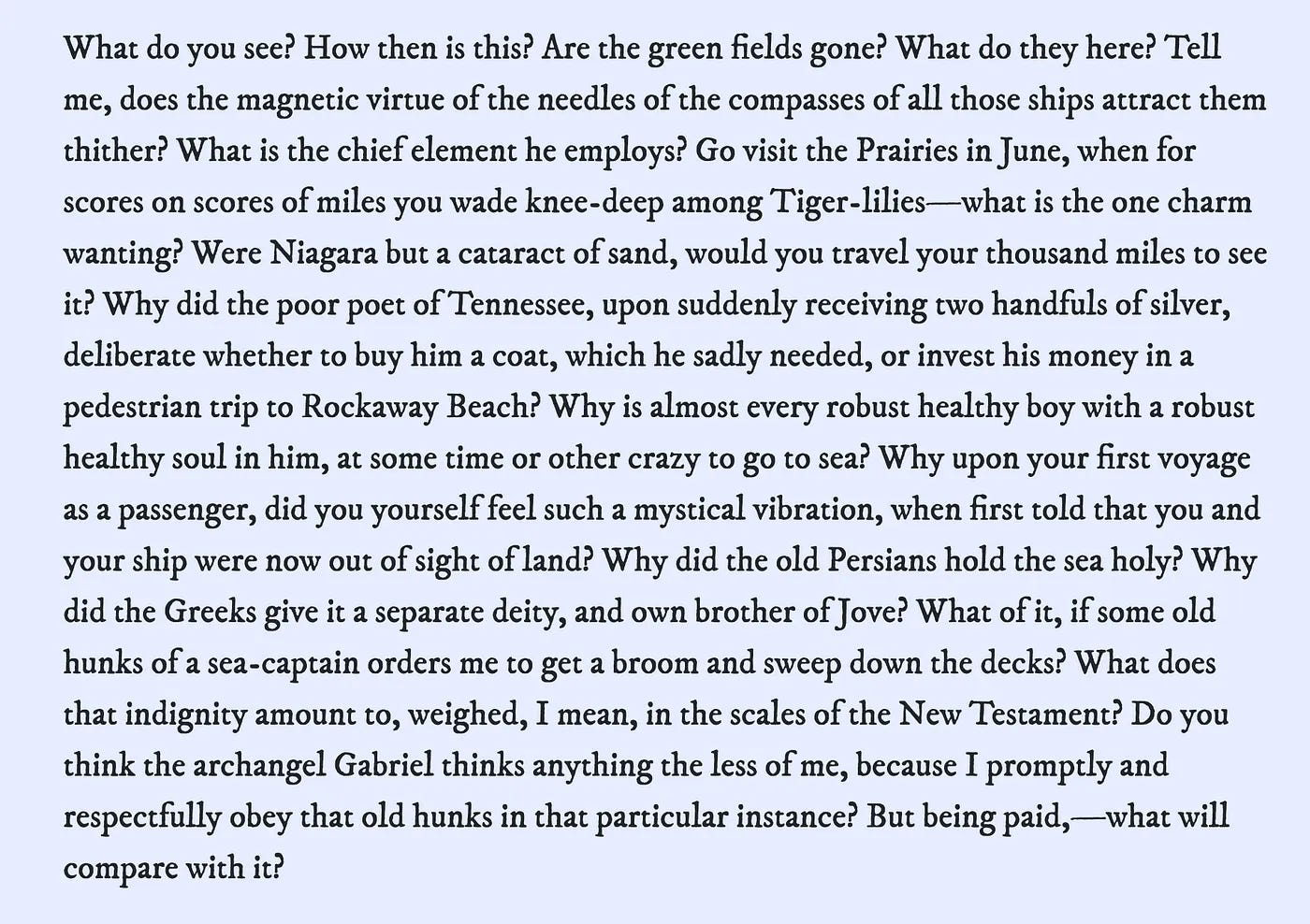
If you’re intrigued by the power of the questions asked by Piaget’s daughter, consider this fabulous tool made by Clive Thompson, which isolates the questions in any piece of writing. Below is what Thompson’s tool came up with for all the questions in the first chapter of Moby Dick:

The very word “question” implies a quest, writes Paul Matthews in his unusual and potent craft book, Sing Me the Creation. Matthews goes on to say:
Without a question we are forever shut out from the inner life of one another. In coming to the question we leave the firm ground of the statement behind and trust ourselves to the in-betweens, for the question is nothing if not open and receptive. This is the ideal it strives for.
In this sense, the question must be, perhaps by far, the most creative of the four sentence types.

So, in this week’s Step Two of the essay intensive, you will not only be guided to “live into the questions,” as Rilke suggests we do, but also encouraged to construct and chisel specific questions on the path to your own lyric essay. What is the point of this foray into questioning? That is, what are we hoping for?
To access your more elusive material: the stories that shy from direct sunlight.
What about those of you who already know what you want your lyric essay to be about—who already know what you want to explore? That’s wonderful! Just keep your intended topic sitting next to you for now—keep it in your line of vision, within easy reach. You’ll be turning to it soon enough, just not quite yet.
First, we must consider our shimmers and shards, turn them over, scatter them on the table, hold them in our palm, scratch at them, pull on them, shuffle them, toss them into the air and let them fall at our feet. We must muse, wonder, search, and yearn.
After all, the word “essay” derives from the French infinitive essayer, “to try” or “to attempt” and in English essay first meant “a trial” or “an attempt.” This etymology suggests that our essays are “tries, trials, attempts, experiments,” all of which are in direct conversation with the heart of what it means to question.
To “essay” as a verb, we must question—and not just “ask a question” for the sake of answering it. We must, instead, with our whole being, truly question.
Here’s how we’ll begin to do that. It’s going to be exhilarating.